Review: Feather Quill and Ink Pot Vector for Stitchers
As a designer who spends half my life staring at screens and the other half watching needles punch through fabric, I have learned to be skeptical of digital assets. We see thousands of Illustrations and Graphics every week, but very few translate well from a flat pixel grid to the textured, dimensional world of thread. When I first pulled up the Feather Quill and Ink Pot Vector, my initial reaction was one of cautious optimism. It promised a vintage aesthetic that is currently trending in boutique branding, but the real question was always going to be: does it stitch out cleanly?
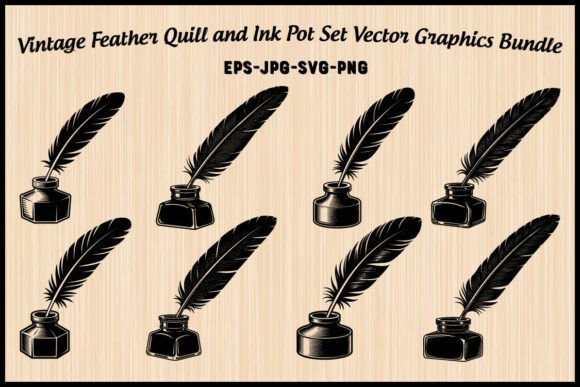
The visual personality of this design is immediately striking. It carries a mood of academic nostalgia and literary romance. For those of us creating handmade products for writers, teachers, or history enthusiasts, this theme hits a sweet spot. The layout balances the organic curve of the feather against the solid, structured base of the ink pot. From a design judgment perspective, this contrast is crucial. In embroidery, we need clear shapes to define the image, and this vector provides distinct boundaries that help prevent the "muddy" look that often plagues complex designs when scaled down.
Real-World Application: The Custom Tote Test
To truly evaluate the Feather Quill and Ink Pot Vector, I moved beyond the screen and considered a specific client project. Imagine a local independent bookstore looking for custom apparel and merchandise for their upcoming author series. They want something sophisticated, not cartoonish. This design fits that brief perfectly.
I visualized this as a tote bag design. Canvas tote bags are forgiving, but they also reveal poor digitizing quickly. The quill’s fine lines would need careful handling. If the stitch density is too high, the fabric puckers; if it is too low, the canvas shows through. In my mental mockup, I saw this working best as a medium-sized placement on the front panel. The vintage vibe adds perceived value to a simple cotton bag, turning a generic item into a personalized gift that feels curated rather than mass-produced.
Another strong contender for this graphic is sweatshirt embroidery. A crewneck sweatshirt in heather grey or deep navy would provide an excellent backdrop. The quill could be rendered in a contrasting cream or gold thread, while the ink pot remains dark. This creates a focal point that draws the eye without overwhelming the garment. For Etsy sellers and small shop product creators, this versatility is key. You are not limited to one niche; you can market this to academics, poets, and even wedding planners looking for unique stationery-themed decor.
Navigating Technical Challenges
While the aesthetic is strong, we must discuss where this design requires caution. Embroidery is a physical medium with limitations. The finest details of the feather barbs are the most vulnerable points. If you attempt to stitch this on a stretchy fabric like a jersey t-shirt without proper stabilization, those delicate lines may distort or break during wear. Similarly, on textured fabrics like terry cloth towels, small details can get lost in the pile.
I would advise against using this specific vector for very small hoop size applications, such as a 2-inch patch or a baby hat brim, unless you are certain the file has been optimized for micro-detail. At tiny scales, the distinction between the quill and the ink pot might blur. For baby embroidery, simplicity is usually safer, so I would recommend scaling this up for a blanket corner or a bib front where there is more surface area for the stitches to breathe.
Curved surfaces present another challenge. If you are applying this to a cap or hat, the curvature can distort the straight lines of the ink pot. You must ensure your hooping technique is flawless and that you use a cut-away stabilizer to maintain shape integrity. For flat items like pillow covers or aprons, these risks are minimized, making them safer bets for beginners or high-volume production runs.
Enhancing Visual Appeal and Brand Value
Why does this matter for your craft business? Because clarity equals professionalism. When a customer sees a crisp, well-defined image, they trust the quality of the entire product. A blurry or poorly stitched design suggests carelessness. The Feather Quill and Ink Pot Vector, when executed correctly, signals attention to detail. It elevates a simple finished product into a piece of art.
For commercial embroidery projects, consistency is vital. If you are producing a batch of items for a boutique, you need a design that reproduces reliably. This vector’s clean lines suggest it will hold up well across multiple runs, provided you keep your thread colors consistent. Using a matte thread for the quill and a slightly shinier rayon for the ink splatter could add subtle depth, enhancing the visual appeal without complicating the stitch path.
Practical Notes for the Studio
Before you commit to a full production run, follow these practical steps. First, always test the design on scrap fabric that matches your final material. Check how the satin stitch handles the curves of the quill and whether the fill stitch in the ink pot is dense enough to cover the fabric but light enough to prevent stiffness.
- Check Contrast: View your design in black and white. If the elements blend together, adjust your thread choices. High contrast ensures the design reads clearly from a distance.
- Verify Licensing: Since this is a digital asset, confirm the license terms. Can you sell the embroidered patch or holiday embroidery items commercially? Most designers allow finished goods sales, but always double-check before listing on Etsy or at craft fairs.
- Stabilizer Selection: For woven fabrics like linen or cotton, a tear-away stabilizer may suffice. For knits or stretchy materials, invest in a cut-away stabilizer to prevent distortion over time.
- Mockup Testing: Create printable mockup images to show clients how the design looks on different backgrounds. This helps manage expectations and reduces revision requests.
In conclusion, the Feather Quill and Ink Pot Vector is a robust addition to any designer’s library of design assets. It bridges the gap between historical charm and modern crafting needs. Whether you are creating digital embroidery file bundles or stitching one-off personalized gifts, this design offers the flexibility and elegance required to stand out in a crowded market. Just remember to respect the technical limits of your machine and fabric, and let the quality of your stitching do the talking.